

Summary
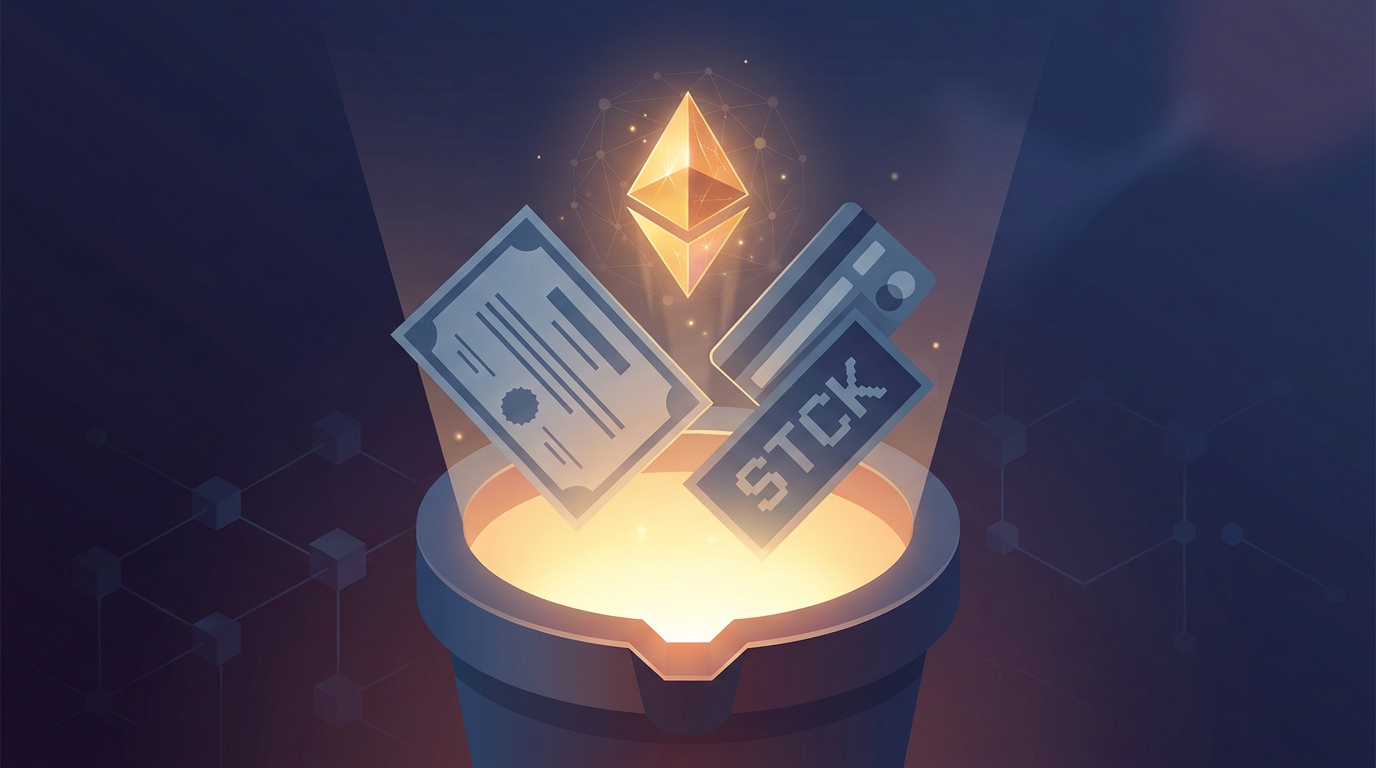
An 11-person team at Grvt has built a perpetual exchange on ZKsync that tokenizes traditional financial assets—stocks, credit, derivatives—into yield-bearing on-chain instruments accessible to retail traders. The project seeks to redefine exchange business models through asset tokenization as trading fees trend toward zero.
From Traditional Finance to On-Chain Trading Evolution
As Robinhood and Charles Schwab drove stock trading commissions to zero, and as cryptocurrency perpetual exchanges process hundreds of billions of dollars in monthly volume, Grvt has chosen to build a different kind of exchange on ZKsync. This 11-person team is not chasing rapid volume growth; instead, it is attempting to reconstruct the fundamental value proposition of exchanges through asset tokenization.
Grvt's core innovation lies in packaging traditional financial assets—stocks, credit instruments, derivatives—into on-chain yield-bearing assets, enabling ordinary investors to access financial products that typically require institutional-grade thresholds. This model represents not just technical innovation but a fundamental rethinking of exchange business models.
The Historical Inevitability of Zero Trading Fees
The history of financial exchanges is essentially a history of declining transaction costs. In 1792, Wall Street brokers agreed to a minimum stock trading commission of 0.25 percent. By 1975, that figure had risen to 1-2 percent. That same year, the U.S. Securities and Exchange Commission deregulated commissions, paving the way for zero-fee trading.
The driving force behind this trend has been advances in information technology. All financial transactions are fundamentally about moving information—recording who exchanged which asset for another. As Moore's Law dramatically reduced the costs of storing, transmitting, and verifying information, the rationale for exchanges to charge substantial fees gradually evaporated.
In 1969, Wall Street began experimenting with the Instinet system, allowing large institutions to trade digitally over networks without human operators at the New York Stock Exchange. This was one of the earliest electronic communication networks (ECNs). During the Black Monday crash of 1987, when traditional phone order channels were overwhelmed, ECNs like Instinet enabled large market participants to continue trading.
The Dual Process of Digitization and Democratization
Financial markets underwent two critical transformation phases: market digitization in the 1980s and market democratization in the 1990s. When Charles Schwab went online in 1996, online trading represented only a small fraction of brokerage business. But by 1999, Charles Schwab had over 3.6 million online accounts and was processing more than one million online trades daily.
In the early 1990s, a retail stock trade cost approximately $40-50 in commissions. A decade later, many online brokers had reduced fees to under $15. Twenty years after that, even that $15 fell to zero. This evolution reflects a fundamental question: when stock trading is reduced to clicking a button, what can exchanges charge for?
In 2001, the Bank for International Settlements predicted that Moore's Law would transform how markets are priced. If everyone could have powerful computing capabilities and networks could transmit ever-larger volumes of information, the way trading worked would fundamentally change. That prediction became reality in 2020, when Robinhood and Charles Schwab made zero-commission trading structures the industry norm.
Exploring New Revenue Models
Once trading commissions reach zero, how do exchanges make money? Traditional financial markets have provided two answers: payment for order flow and interest income on idle funds. Exchanges sell aggregated information about user order behavior to market makers or profit through proprietary market-making divisions. Meanwhile, idle funds in user accounts also generate interest income for exchanges.
Grvt's yield-bearing asset model can be seen as an extension of this profit logic. By tokenizing traditional financial assets into on-chain yield-bearing instruments, the project attempts to create a new value layer: not just providing a trading channel but making the assets themselves generate returns. Under this model, the exchange's role transforms from a simple matching platform to a full-stack financial services provider.
Institutional-Grade Infrastructure Needs for On-Chain Trading
For institutional investors and professional traders, an exchange's value lies not just in low fees but in reliable infrastructure, transparent settlement mechanisms, and comprehensive risk management tools. Grvt's choice to build on ZKsync, leveraging zero-knowledge proof technology to provide verifiable transaction records, holds significant importance for institutional clients requiring compliance audits.
The tokenization of yield-bearing assets also involves complex custody and clearing issues. In traditional financial markets, stock settlement once required five days and involved multi-party reconciliation from banks to stock custodians. Blockchain technology can theoretically streamline this process dramatically, but practical implementation still requires addressing challenges such as asset authenticity verification, cross-chain interoperability, and regulatory compliance.
Thresholds and Risks for Retail Participation
One of Grvt's goals is to enable retail investors to access on-chain financial product trading traditionally limited to institutions. This democratization vision continues the ethos of 1990s online brokers but also introduces new considerations.
Yield-bearing assets often involve more complex risk structures. The revenue sources for stocks, credit instruments, and derivatives vary significantly, as do their risk characteristics. For retail investors lacking specialized knowledge, understanding the risks of these complex products may be challenging. Additionally, the irreversibility of on-chain transactions and smart contract risks are factors that warrant careful consideration.
Retail investors exploring such platforms should conduct thorough due diligence, understanding product mechanics, fee structures, and the risks inherent in both the underlying assets and the blockchain infrastructure. The novelty of yield-bearing tokenized assets means that historical performance data may be limited, and unforeseen technical or market risks could emerge.
Regulatory Environment Uncertainty
Tokenizing traditional financial assets and trading them on-chain inevitably involves complex regulatory issues. Different jurisdictions have varying regulatory requirements for security tokens, derivatives trading, and cross-border capital flows. Projects like Grvt must find a balance between innovation and compliance.
The regulatory framework for traditional financial markets has matured over decades. However, regulation of crypto assets and decentralized trading is still evolving. Project teams must closely monitor regulatory developments to ensure business model sustainability. For users considering participation in such platforms, understanding relevant regulatory risks is an important part of due diligence.
The lack of regulatory clarity in many jurisdictions creates uncertainty for both platform operators and users. What constitutes a security token? How should cross-border transactions be treated? What investor protections apply? These questions remain open in many markets, and regulatory stances can shift as authorities grapple with new technologies.
Long-Term Trends in Exchange Evolution
Grvt's experiment reflects a long-term trend in exchange evolution: the shift from simple matching platforms to comprehensive financial service providers. As the marginal cost of trading itself approaches zero, an exchange's value increasingly manifests in providing full-stack services, managing assets, and sharing yields.
This trend is evident in both traditional finance and cryptocurrency. Traditional brokers offer wealth management, retirement accounts, lending services, and other comprehensive offerings; crypto exchanges are also expanding into staking, lending, and asset management. The yield-bearing asset model can be viewed as a continuation of this trend, attempting to bring more traditional financial products into the on-chain environment.
From a broader perspective, the digitization and democratization of financial markets continue. From institutional digital trading in the 1980s to retail online trading in the 1990s to today's on-chain asset trading, each step has lowered participation thresholds and increased market efficiency. The explorations of projects like Grvt represent the latest stage in this evolutionary process.
Custody and Infrastructure Considerations
For institutional participants and sophisticated traders, robust custody solutions are essential when engaging with tokenized yield-bearing assets. The security of private keys, the reliability of smart contracts, and the transparency of settlement processes all factor into risk assessments.
While Grvt's use of ZKsync provides verifiable transaction records through zero-knowledge proofs, the broader ecosystem of custody providers, auditors, and risk management tools is still maturing. Institutions evaluating such platforms will scrutinize not just the exchange itself but the entire infrastructure stack supporting asset custody and settlement.
The interplay between on-chain transparency and institutional custody requirements presents both opportunities and challenges. Transparency can enhance auditability and reduce counterparty risk, but it also requires careful management of sensitive information and compliance with privacy regulations in various jurisdictions.
Market Structure and Liquidity Dynamics
The success of any exchange, traditional or on-chain, ultimately depends on liquidity. For yield-bearing assets that tokenize traditional financial instruments, liquidity provision may involve different dynamics than standard spot or perpetual markets.
Market makers must account not just for price volatility but also for the underlying yield accrual mechanisms and the risks associated with the tokenized assets. This complexity may initially limit liquidity provision to specialized participants, potentially resulting in wider spreads and higher implicit costs for traders.
As the market matures, algorithmic strategies and improved infrastructure could enhance liquidity. However, the path to deep, efficient markets for tokenized yield-bearing assets is likely to be gradual, requiring patience from both platform operators and early adopters.
Concluding Observations
Grvt's initiative to build a yield-bearing asset perpetual exchange on ZKsync represents an interesting experiment at the intersection of traditional finance and decentralized infrastructure. By attempting to tokenize stocks, credit instruments, and derivatives into on-chain yield-bearing assets, the project seeks to address a fundamental challenge: how can exchanges create value when trading fees trend toward zero?
The historical arc from high-commission brokerage to zero-fee trading in traditional markets suggests that exchanges must evolve beyond simple transaction facilitation. Full-stack financial services, asset management, and yield sharing may become primary value drivers. Grvt's model is one attempt to realize this vision in an on-chain context.
However, technological innovation does not eliminate the inherent risks of financial markets. Whether traditional exchanges or on-chain platforms, investors must fully understand product characteristics, assess their own risk tolerance, and seek professional advice when necessary. For emerging yield-bearing asset trading models, maintaining a cautious stance is especially important.
The regulatory landscape remains uncertain, the infrastructure is still maturing, and market liquidity for these novel instruments is unproven. These factors underscore the importance of careful evaluation and risk management for any participant considering engagement with such platforms. As the ecosystem develops, clearer regulatory frameworks, improved custody solutions, and deeper liquidity may emerge—but the timeline and ultimate structure of this evolution remain open questions.
Source: link